Our Location
304 North Cardinal St.
Dorchester Center, MA 02124

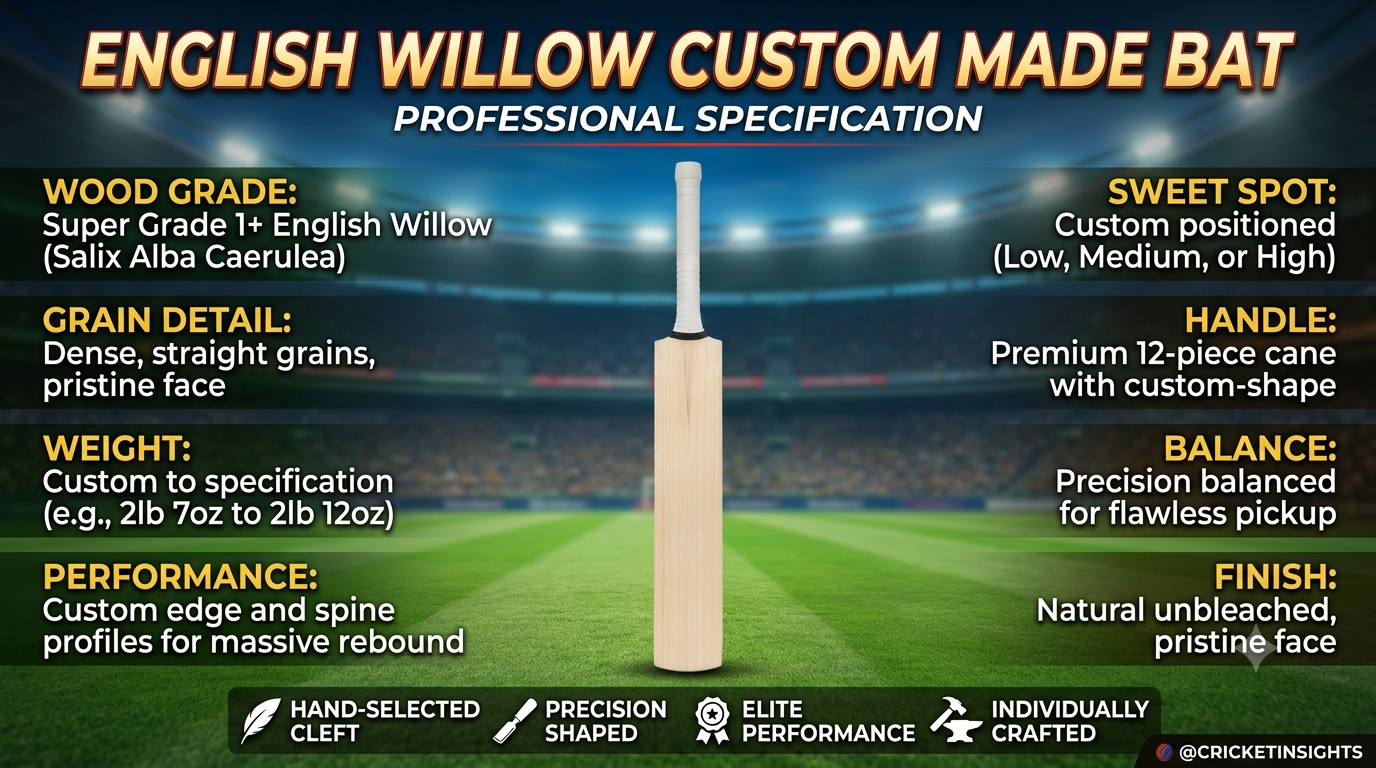
A custom made English willow cricket bat is designed for players who want more than a standard off-the-shelf bat. From willow selection and grain quality to bat weight, sweet spot, edges, spine, handle and balance, every specification can be adjusted to match the player’s technique and playing style.
For serious cricketers, a well-made professional English willow bat can provide the combination of pickup, balance, stroke response and power required for high-level cricket.
A custom made English willow bat is individually prepared according to the player’s requirements. Instead of selecting only from fixed factory specifications, the player can choose important characteristics such as:
The objective is not simply to make the heaviest or biggest bat. The goal is to create a bat that feels comfortable, balanced and powerful in the player’s hands.
Premium cricket bats are generally made from English willow, traditionally associated with high-quality cricket bat production in the UK.
For a premium custom bat, willow selection is one of the most important stages. Straight grains, cleft quality, moisture condition, density and overall wood characteristics influence the final appearance and performance of the bat.
If a bat is advertised as 100% UK-grown English willow, the seller should be able to stand behind that claim and provide appropriate assurance regarding the source of the willow.
English willow is not graded solely by the number of grains. Grain straightness, cleft quality, density, blemishes, growth characteristics and the overall performance of the individual cleft all matter.
There is no single “best” cricket bat shape. Different profiles are designed to produce different combinations of sweet spot, pickup, power and balance.
The most common professional bat profiles include:
The sweet spot is positioned around the middle of the blade.
Advantages:
This is one of the most popular choices for players who want an all-round professional cricket bat.
The thickest part of the blade and sweet spot are positioned lower toward the toe.
Advantages:
A low sweet spot can also be useful for players who naturally strike the ball lower on the blade.
The sweet spot is positioned higher on the blade.
Advantages:
A full-profile bat maintains substantial wood behind the hitting area and can provide a large hitting zone.
Advantages:
The actual profile should always be selected according to the player’s technique rather than simply choosing the largest possible edges.
A mid-low profile combines characteristics of mid and low sweet-spot bats.
It can be an excellent option for players who want a strong driving area while still maintaining good pickup and versatility.
Two bats can have exactly the same weight but feel completely different in the hands.
This is because balance and weight distribution affect the pickup.
For example:
2.9 lb bat + excellent balance
can feel easier to manoeuvre than
2.8 lb bat + heavy pickup.
When making a custom cricket bat, the maker considers where the weight is concentrated.
More weight is felt toward the blade.
Benefits:
Weight is distributed more evenly between the handle and blade.
Benefits:
The bat can have a relatively substantial blade while being shaped to provide a lighter pickup.
Benefits:
The important point is that bat weight alone does not determine pickup.
Professional players use different bat profiles according to their technique, strength, playing position and personal preference.
Some players are associated with more traditional full profiles, while others prefer lighter pickup, thicker edges, pronounced spines or different sweet-spot positions.
However, a player’s exact bat specification should not simply be copied.
For example, a professional player’s bat may be designed around their:
Therefore, a custom cricket bat inspired by a professional player’s profile should still be adjusted to suit the individual player.
Bat weight is one of the most important customisation options.
Common adult cricket bat weights are approximately:
| Player Type | Typical Bat Weight |
|---|---|
| Lightweight adult | 2.6–2.8 lb |
| Medium | 2.8–2.10 lb |
| Heavy | 2.10–2.12+ lb |
| Professional preference | Depends on player |
These are general ranges, not official requirements.
A heavier bat does not automatically produce more runs. A player must be able to control the bat comfortably and generate sufficient bat speed.
For a custom bat, pickup should be considered together with actual weight.
Cricket bats used under international playing conditions must comply with the applicable laws and playing regulations.
Under the current Laws of Cricket, the maximum overall bat length is 38 inches (96.52 cm). The blade may not exceed:
The handle cannot exceed 52% of the overall length for bats above size 6. Bats must also comply with the applicable bat-gauge requirements.
The ICC introduced these bat-size restrictions to maintain an appropriate balance between bat and ball, including limits on edge thickness and overall depth.
These are maximum permitted dimensions, not recommendations that every cricket bat should be manufactured at the maximum size.
A professional custom bat can have smaller edges, a different spine, a different sweet-spot position and a different profile while remaining within the permitted dimensions.
The handle plays an important role in comfort, control and shock absorption.
A traditional cricket bat handle is primarily made using cane and/or wood, with the upper portion used for holding the bat and normally covered by a grip. ICC playing conditions specify the handle construction requirements.
A custom bat can be prepared with different handle preferences depending on the player’s requirements.
The handle affects:
For this reason, handle selection is an important part of professional bat customisation.
The edges are the thicker outer sections of the blade.
Larger edges can contribute to a larger hitting area, but the bat must remain within the applicable maximum dimensions.
Under the current laws, the maximum edge thickness is 40 mm.
The spine is the raised central section running along the back of the blade.
A pronounced spine can help create a substantial hitting area while allowing the batmaker to manage the overall distribution of wood.
A professional batmaker carefully balances:
Spine + edges + sweet spot + toe + shoulders + pickup
rather than maximising one specification.
The toe is another area that can be customised.
Common designs include:
The appropriate toe depends on the overall bat profile and the player’s preferred balance.
A well-designed toe should work together with the sweet spot and lower blade profile rather than being selected independently.
This is one of the biggest misconceptions about English willow bats.
More grains do not automatically mean a better-performing bat.
The number of visible grains can be one indicator of the willow’s growth characteristics, but it is not a complete measure of quality.
A bat should be evaluated based on:
A professional batmaker selects the cleft based on the characteristics of the individual piece of willow.
A quality custom made English willow bat goes through several stages.
The batmaker selects an appropriate English willow cleft based on grain structure, quality and the intended grade of the finished bat.
The willow must be appropriately prepared and conditioned before the bat is manufactured.
The cleft is shaped to establish:
A suitable handle is fitted into the blade using the appropriate splice construction.
The willow is pressed to help prepare the blade for cricket-ball impact while maintaining the desired profile.
The blade is carefully sanded and finished to create a smooth, professional surface.
The appropriate grip is fitted according to the player’s preference.
The bat is prepared for use through the appropriate knocking-in process. This is important because a new willow bat should not simply be taken onto the field and immediately exposed to maximum-speed impacts.
The completed bat is checked for:
A standard bat may work perfectly for one player but feel completely different to another.
A custom bat allows the specifications to be adjusted around the player.
Weight: According to player preference
Balance: Head-heavy, even or lighter pickup
Sweet spot: High, mid, low or mid-low
Handle: Custom handle preference
Edges: According to profile and regulations
Spine: Designed around the desired profile
Toe: Custom profile
Bow: According to playing style
Grip: Player preference
Height: Appropriate bat size
Stickers: Personalised branding/design
Name engraving: Personalisation where offered
English willow and Kashmir willow are both used to manufacture cricket bats, but they are not the same material.
Generally preferred for premium and professional-level bats because of its performance characteristics and traditional use in high-level cricket.
Often provides a more economical option and can be an excellent choice for club, recreational, junior and developing players depending on the individual bat.
The right choice depends on the player’s level, budget and requirements.
Before ordering a custom cricket bat, consider these factors:
Are you primarily a front-foot player, back-foot player or all-round stroke player?
Choose a weight that you can control comfortably throughout an innings.
Don’t judge the bat only by the number printed on the weighing scale. Test how it feels in your hands.
Choose high, mid, low or mid-low according to your natural contact point and playing conditions.
Choose a handle that provides the comfort and control you need.
A profile that works well on a particular type of pitch may not necessarily be ideal everywhere.
Look beyond grain count and consider the overall quality of the cleft.
A professional cricket bat should be more than an attractive piece of equipment.
It should provide a combination of:
Quality Willow + Correct Profile + Balance + Pickup + Control + Power
The best custom bat is the one that feels natural in the player’s hands and complements their technique.
Whether you are an academy player, club cricketer, professional player or serious cricket enthusiast, a properly customised English willow cricket bat can be built around your individual requirements.
We specialise in professionally crafted custom English willow cricket bats, with attention to willow selection, profile, balance, weight and finish.
Every player has different requirements, which is why our custom bat process can be adjusted according to the player’s preferred:
Our objective is to deliver a professional-grade custom cricket bat that combines traditional craftsmanship with modern bat-making requirements.
English willow is generally preferred for premium and professional cricket bats because of its performance characteristics. However, the quality of the individual bat matters greatly.
The current Laws specify a maximum overall length of 38 inches (96.52 cm), maximum blade width of 4.25 inches (10.8 cm), maximum depth of 2.64 inches (6.7 cm) and maximum edge thickness of 1.56 inches (4.0 cm).
There is no universally best shape. Mid, low, high and mid-low sweet-spot profiles suit different playing styles.
Not necessarily. The ideal bat is one that the player can control comfortably while maintaining good bat speed and balance.
No. Grain count alone does not determine bat quality. Willow characteristics, density, grain structure, profile, balance and performance all matter.
Customisation means adjusting the bat’s specifications according to the player’s requirements, such as weight, balance, sweet spot, handle, profile, edges and grip.
