Our Location
304 North Cardinal St.
Dorchester Center, MA 02124

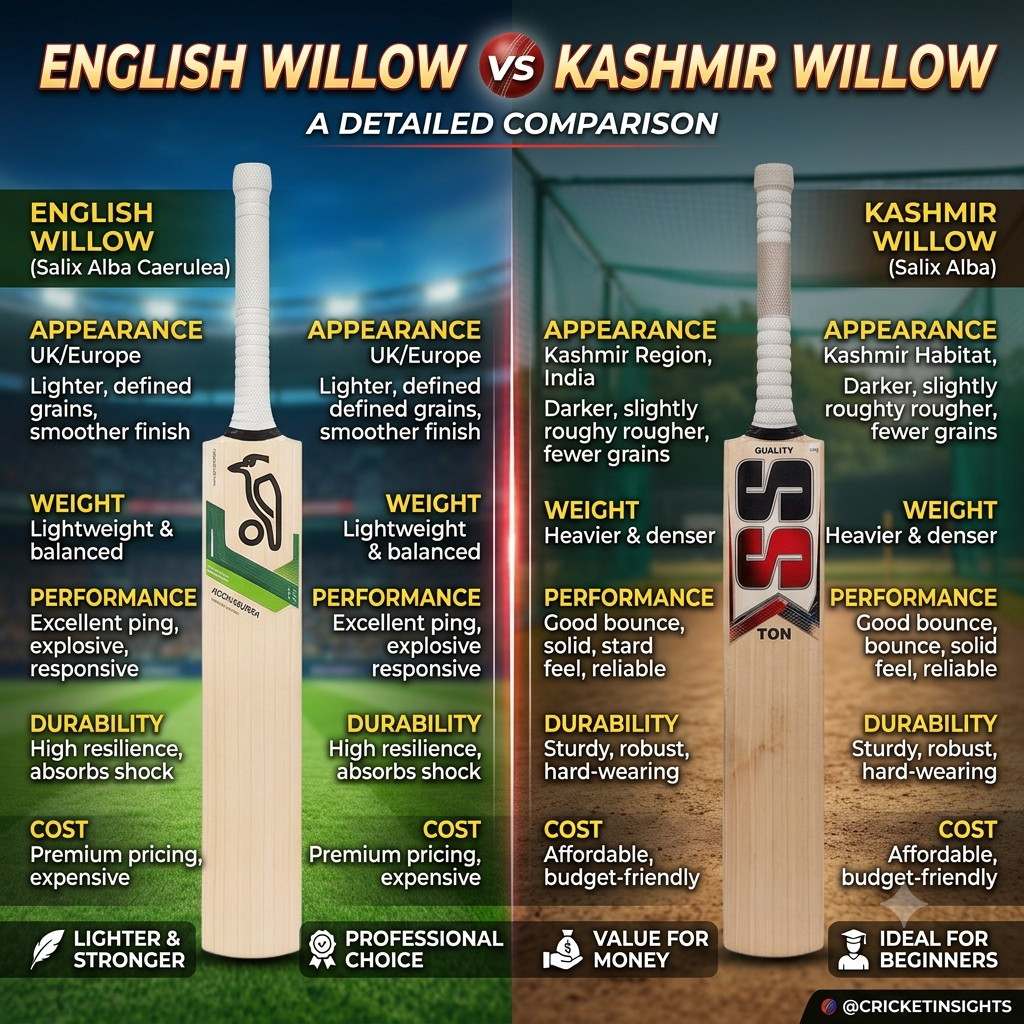
Choosing the right cricket bat is one of the most important decisions for every cricketer. Whether you are a beginner, a club-level player, a professional cricketer, or a cricket equipment retailer, understanding the difference between Kashmir Willow and English Willow can help you make the right choice.
Both types of willow are widely used in cricket bat manufacturing, but they differ in weight, wood characteristics, playing feel, price, and target customers.
English Willow cricket bats are generally preferred by competitive and professional players who want excellent responsiveness, a lightweight pickup, and high performance with a leather cricket ball. In comparison, Kashmir Willow cricket bats are popular among beginners, school players, tennis-ball cricketers, recreational players, and customers looking for an affordable cricket bat.
But which willow is actually better? Where does each type of willow grow? How much does each cricket bat cost? And which type has greater market demand?
In this comprehensive guide, we will explore everything you need to know about Kashmir Willow vs English Willow cricket bats.
Before discussing the details, let’s compare the two types of cricket bats.
| Feature | Kashmir Willow Cricket Bat | English Willow Cricket Bat |
|---|---|---|
| Primary growing region | Kashmir Valley, India | England, United Kingdom |
| Wood characteristics | Generally denser and harder | Generally softer and more responsive |
| Colour | Often darker or brownish | Usually lighter or cream-coloured |
| Weight | Often heavier for a similar profile | Often lighter for a similar profile |
| Batting performance | Good performance depending on quality | Excellent responsiveness in well-made bats |
| Durability | Suitable for regular practice and rougher conditions | Requires careful handling and preparation |
| Price | Generally more affordable | Generally more expensive |
| Best suited for | Beginners, practice, recreational cricket | Competitive cricket and leather-ball matches |
| Tennis-ball cricket | Popular choice | Can be used, but may not be necessary |
| Professional leather-ball cricket | Suitable depending on the bat and competition | Commonly preferred |
| Maintenance | Requires appropriate care | Requires careful knocking-in and maintenance |
Important: The actual performance of a cricket bat depends on its wood quality, moisture content, pressing, blade profile, weight, handle construction, and craftsmanship. Willow type alone does not guarantee better performance.
Kashmir Willow is the wood used to manufacture cricket bats from willow trees grown in the Kashmir region of India.
The Kashmir Valley has a long history of cricket bat manufacturing, with important production areas in and around Anantnag, Bijbehara, and other parts of South Kashmir.
The region’s bat-making industry is known for producing cricket bats for domestic markets and international customers.
Kashmir Willow is generally denser and harder than the traditional English Willow used in premium cricket bats. This can make Kashmir Willow bats suitable for regular practice, recreational cricket, and players who prefer a solid-feeling bat.
1. Affordable Pricing
Kashmir Willow bats are generally available at lower prices than comparable English Willow bats. This makes them attractive to beginners, students, academies, and budget-conscious players.
2. Solid Feel
The denser nature of Kashmir Willow can provide a solid feel when striking the ball. However, the actual rebound and power depend on the quality of the wood and how the bat has been manufactured.
3. Suitable for Practice
Kashmir Willow bats are widely used for net practice, school cricket, local matches, recreational cricket, and various forms of tennis-ball cricket.
4. Multiple Price Categories
Kashmir Willow bats are available in different quality levels, from basic entry-level models to carefully selected premium bats.
5. Popular in the Indian Market
Their affordability makes Kashmir Willow bats particularly attractive to customers who want a cricket bat for everyday use without spending a large amount of money.
A Kashmir Willow cricket bat can be a suitable option for:
If your main priority is value for money and regular practice, Kashmir Willow deserves serious consideration.
English Willow is the traditional premium wood used in many high-performance cricket bats.
It is primarily grown in England, particularly in parts of eastern and southeastern England, where suitable growing conditions support the production of cricket bat willow.
English Willow used for cricket bats is commonly associated with Salix alba var. caerulea.
The wood is valued for its relatively low density, fibrous structure, and ability to provide excellent rebound when a bat is properly manufactured.
Many professional and competitive cricketers prefer English Willow because a well-selected bat can offer excellent responsiveness, good pickup, and a desirable balance between power and control.
1. Excellent Responsiveness
A well-made English Willow bat can offer a lively response when the ball strikes the middle of the blade. This is one reason the wood is widely used in premium cricket bats.
2. Lightweight Pickup
English Willow is generally lighter for a comparable blade volume than denser willow. This allows manufacturers to design bats with substantial profiles while maintaining a manageable pickup.
However, two bats made from English Willow can still feel very different depending on their weight distribution and shape.
3. Suitable for Leather-Ball Cricket
English Willow bats are widely used in club cricket, league matches, competitive cricket, and professional cricket.
4. Premium Product Category
English Willow bats are available in multiple grades and price categories. Premium models can cost considerably more than entry-level bats.
5. Requires Proper Preparation
English Willow is relatively soft and can be damaged if it is not prepared correctly. Proper knocking-in, suitable oiling where appropriate, and careful maintenance are important for many English Willow bats.
English Willow can be an excellent choice for:
A higher price does not automatically mean a bat will perform better for every player. Selecting the correct weight, profile, and balance is equally important.
Kashmir Willow is associated with the Kashmir Valley in northern India.
Willow trees suitable for cricket bat manufacturing are cultivated in parts of the region, and the local industry has developed considerable expertise in selecting, processing, shaping, and finishing willow for cricket bats.
South Kashmir: Areas including Bijbehara and surrounding parts of Anantnag district are associated with cricket bat manufacturing.
Other parts of the Kashmir Valley: Willow cultivation, wood processing, and bat production also support the wider regional industry.
The region’s cricket bat manufacturers supply different types of bats, including entry-level Kashmir Willow bats and selected premium models.
Kashmir Willow supports a regional manufacturing industry that serves several customer groups.
These include:
The availability of locally grown willow also gives manufacturers an important domestic raw material for producing affordable cricket bats.
However, the quality of individual bats can vary considerably. Good manufacturing practices and careful wood selection remain essential.
English Willow is primarily associated with England in the United Kingdom.
Suitable willow trees are grown in parts of England where the climate and growing conditions support the development of wood used for cricket bat manufacturing.
The wood is harvested and processed into clefts or bat blanks before being shaped into finished cricket bats.
English Willow is valued for its physical characteristics and suitability for high-performance cricket bats.
Several factors contribute to its premium position:
Not every English Willow cleft is premium quality. Natural differences in grain, density, blemishes, and structural characteristics affect the quality of the finished bat.
The word “English Willow” identifies the wood type, not a guarantee that the bat is Grade 1.
Let’s examine the most important differences from a player’s perspective.
Weight is one of the most important factors when selecting a cricket bat.
Kashmir Willow is generally denser than English Willow. Consequently, a Kashmir Willow bat can be heavier than an English Willow bat with a similar blade shape and volume.
English Willow allows manufacturers to create relatively lightweight bats with substantial edges and a pronounced spine.
However, the actual pickup also depends on the distribution of weight throughout the blade.
Best choice: English Willow often suits players who prioritise lightweight pickup, but a properly balanced Kashmir Willow bat can also feel comfortable.
Rebound refers to how the ball responds when it strikes the bat.
English Willow is widely valued for its responsive feel and ability to transfer energy effectively during contact.
Kashmir Willow can also perform well, particularly when the bat is made from carefully selected wood and manufactured correctly.
Factors such as pressing, blade profile, impact location, ball type, and the player’s technique influence performance.
Best choice: English Willow is generally preferred for its performance characteristics in competitive leather-ball cricket.
Durability depends on the quality of the wood, the bat’s preparation, the type of ball used, and the conditions in which it is played.
Kashmir Willow’s denser structure can make it suitable for regular practice and some rougher playing conditions.
English Willow is generally softer and can be more vulnerable to surface damage if it is not prepared or maintained correctly.
Neither type is indestructible. A poorly manufactured Kashmir Willow bat may fail early, while a well-maintained English Willow bat can provide excellent service.
Most new English Willow bats require proper knocking-in before being used with a hard leather cricket ball, unless the manufacturer provides specific preparation instructions.
The purpose is to prepare the blade’s surface for impact and reduce the risk of premature damage.
Kashmir Willow bats also benefit from appropriate preparation and maintenance, depending on the manufacturer and intended use.
For both types:
Price is one of the biggest reasons customers choose Kashmir Willow over English Willow.
Kashmir Willow bats generally occupy the affordable and mid-range categories. English Willow bats are available across a much wider premium range.
For a beginner, an affordable Kashmir Willow bat may provide better value than an expensive English Willow bat that exceeds the player’s needs.
For a competitive leather-ball player, spending more on a suitable English Willow bat may be worthwhile.
The best purchase is the bat that matches the player’s ability, playing conditions, and budget.
Cricket bat prices vary according to the quality of the wood, manufacturing standards, brand, bat profile, handle, finishing, and retailer margins.
The following ranges are indicative retail estimates rather than fixed market prices.
| Cricket Bat Category | Approximate Retail Price in India | Target Customer |
|---|---|---|
| Basic Kashmir Willow | ₹800–₹1,500 | Beginners and casual players |
| Standard Kashmir Willow | ₹1,500–₹3,000 | School players and regular practice |
| Premium Kashmir Willow | ₹3,000–₹6,000 | Club players and experienced recreational players |
| Selected premium Kashmir Willow | ₹6,000–₹8,000+ | Buyers seeking higher-end Kashmir Willow |
| Entry-level English Willow | ₹5,000–₹10,000 | Players upgrading to English Willow |
| Mid-range English Willow | ₹10,000–₹20,000 | Regular leather-ball cricketers |
| Higher-grade English Willow | ₹20,000–₹35,000 | Competitive players |
| Premium English Willow | ₹35,000–₹60,000+ | Advanced and professional players |
Actual prices may fall outside these ranges. Brand positioning, retailer promotions, and individual bat specifications can create substantial differences.
These are retail estimates, not wholesale purchase prices. Retailers should calculate wholesale prices using their actual procurement costs, taxes, shipping expenses, discounts, and desired margins.
There is no single, reliable public dataset establishing the exact percentage of Indian cricket bat sales attributable to Kashmir Willow versus English Willow.
Demand also varies by location, customer income, playing format, competition level, and sales channel.
However, the two categories serve different market segments.
Kashmir Willow has a strong position in the affordable cricket equipment market.
Its customer base includes:
Its relatively affordable price makes it attractive to customers who need a dependable bat for regular practice.
For manufacturers and wholesalers, Kashmir Willow offers opportunities to sell through volume-oriented channels, particularly where customers prioritise price and everyday usability.
English Willow serves a different customer segment.
Its customers often include:
English Willow bats can command higher selling prices, especially when they feature carefully selected wood, excellent balance, premium finishing, and reputable branding.
However, the higher price can make this category less accessible to entry-level customers.
For a business, the answer depends on the market being targeted.
Kashmir Willow may offer broader opportunities in affordable and volume-oriented segments, while English Willow can offer opportunities in premium and performance-oriented segments.
This is a market-positioning assessment, not a verified nationwide sales ranking. Actual sales volumes and profitability should be measured using retailer data, marketplace reports, and your own sales history.
Cricket bat demand outside India depends on the popularity of cricket, local playing conditions, customer purchasing power, and the availability of cricket equipment.
Different markets may favour different product categories.
India has a broad customer base, ranging from beginners and recreational players to professional cricketers.
Kashmir Willow can be attractive to customers looking for affordable bats, while English Willow serves players seeking premium performance.
Both categories have opportunities in physical sports shops, online marketplaces, academies, and wholesale distribution.
The United Kingdom has an established market for cricket equipment, including premium English Willow bats.
Club cricket, league cricket, school cricket, and recreational cricket create demand for different bat types and price points.
English Willow is an important premium category, although the best product for an individual customer depends on their playing level and budget.
Australia has an established cricket equipment market supported by club cricket, school cricket, and competitive cricket.
Players seeking premium leather-ball equipment can be an important target segment for English Willow bats.
Affordable bats can also serve beginners and recreational players.
Pakistan has a strong cricket culture and a diverse cricket equipment market.
Demand varies between premium leather-ball bats and more affordable products used for practice and recreational cricket.
Manufacturers and retailers should assess local preferences and import requirements before choosing a product range.
Both countries have established cricket communities and customers across multiple playing levels.
Affordable cricket bats can appeal to beginners and recreational players, while English Willow bats can serve competitive and advanced players.
Markets in countries such as South Africa, New Zealand, the United Arab Emirates, and other cricket-playing regions may also offer opportunities.
However, demand should not be assumed to be identical across these countries.
For exporters, the most effective strategy is to identify a target country, research competing products, compare landed prices, and understand the playing conditions before deciding which willow category to promote.
Kashmir Willow is often a practical choice for tennis-ball cricket because it is generally more affordable and can provide a solid feel.
It may be suitable for:
However, the best bat also depends on the tennis ball being used.
A lightweight tennis ball, a heavy tennis ball, and a taped tennis ball place different demands on a bat.
Players should select a bat that suits the ball, their playing style, and the manufacturer’s recommendations.
English Willow can also be used for tennis-ball cricket, but a premium English Willow bat may not provide the best value if the player does not need its performance characteristics.
For competitive leather-ball cricket, English Willow is a common choice because of its responsiveness, pickup characteristics, and availability in premium performance grades.
It is particularly popular among players who want to develop timing, control, and attacking shots.
Nevertheless, Kashmir Willow can also be used for leather-ball cricket when the bat is suitable for the ball and playing conditions.
For beginners learning leather-ball cricket, an appropriately sized and balanced Kashmir Willow bat may be a sensible starting point.
For advanced players, an English Willow bat selected according to weight, profile, balance, and personal preference may offer a more suitable performance experience.
The key is to choose the bat according to your level of cricket rather than assuming that a more expensive bat will automatically improve your performance.
If you are buying or selling Kashmir Willow bats, examine more than the sticker or grade printed on the bat.
Consider these factors:
1. Wood Quality
Look for a structurally sound blade without serious cracks, deep splits, or obvious manufacturing defects.
2. Grain Structure
Examine the visible grain and its consistency. Grain count alone is not a reliable indicator of overall Kashmir Willow quality.
3. Weight and Pickup
Choose a bat that feels manageable and allows the player to play shots comfortably.
4. Pressing and Finish
Check that the blade has been pressed and finished appropriately for its intended use.
5. Handle Quality
The handle should be securely fitted and comfortable to hold.
6. Manufacturing Consistency
For wholesale purchases, inspect samples from different bats to ensure consistent quality across the batch.
English Willow bats are available in different grades, but grading terminology is not perfectly standardised across all manufacturers.
A Grade 1 label from one seller may not represent exactly the same selection criteria as a Grade 1 label from another.
Consider the following factors:
1. Straight Grain Structure
Straight and reasonably even grains can be a useful selection feature, although grain count alone does not determine performance.
2. Wood Condition
Check for significant cracks, structural defects, and unsuitable moisture conditions.
Natural marks and variations can occur in genuine willow.
3. Weight and Balance
The bat should suit the player’s strength, technique, and preferred style of play.
4. Pressing Quality
Proper pressing helps determine how the blade responds and how it handles repeated impacts.
5. Blade Profile
Consider the spine, edges, toe shape, sweet spot, and overall balance.
6. Authenticity
Purchase from a trustworthy manufacturer or supplier who can explain the origin of the willow.
A pale-coloured blade or a high grain count does not, by itself, prove that a bat is genuine English Willow.
For manufacturers, wholesalers, and cricket equipment retailers, choosing between Kashmir Willow and English Willow is not only a product decision. It is also a business strategy.
Both categories can contribute to a successful cricket bat business when the product range matches customer demand.
Kashmir Willow can be positioned as an affordable, practical product for beginners and regular practice.
Potential customers include:
A retailer can offer multiple price points by developing entry-level, standard, and premium Kashmir Willow ranges.
The focus should be on consistent quality, reliable construction, suitable bat weights, and competitive pricing.
English Willow can be positioned as a premium product for competitive players.
Potential customers include:
Retailers can differentiate products by clearly communicating willow authenticity, bat weight, blade profile, manufacturing quality, and preparation requirements.
The answer depends on the customers the wholesaler serves.
A business supplying school shops and budget-conscious retailers may benefit from a stronger Kashmir Willow range.
A specialist supplier serving leather-ball clubs and advanced players may need a broader English Willow range.
A business selling through both channels can offer both categories at different price points.
Before investing in a large inventory, consider:
Rather than assuming one type will always sell better, test demand with a smaller assortment and expand the categories that perform well.
If you sell cricket bats online, the way you present your products can influence customer understanding and purchasing decisions.
Examples include:
Only use terms such as “Grade 1,” “professional,” or “lightweight” when the product genuinely meets the relevant description.
Consider creating dedicated categories for:
Clear categories help customers find products according to their needs.
Explain the willow type, recommended ball type, weight, size, handle, blade profile, and intended player level.
Avoid claiming that every English Willow bat is better than every Kashmir Willow bat. Accurate descriptions help customers make informed decisions and can reduce returns.
Useful topics include:
Educational content can attract customers who are researching products before making a purchase.
Neither is universally better. Kashmir Willow is generally more affordable and denser, while English Willow is commonly preferred for its responsive feel and performance in competitive leather-ball cricket.
Generally, yes, when comparing similar blade volumes. However, the finished bat’s weight and pickup depend on its design, dimensions, and wood selection.
English Willow is commonly preferred by competitive and professional leather-ball players. The ideal bat still depends on individual preferences, playing conditions, and the quality of the finished product.
Yes, a suitable Kashmir Willow bat can be used for leather-ball cricket. Players should choose a bat appropriate for the ball, playing conditions, and competition.
Kashmir Willow bats are generally more affordable than comparable English Willow bats.
Kashmir Willow is a popular practical choice because of its price and solid feel. The appropriate bat depends on the type of tennis ball and how the player uses it.
Kashmir Willow is associated with the Kashmir Valley in northern India, where willow cultivation and cricket bat manufacturing support an established regional industry.
English Willow used for cricket bats is primarily associated with England in the United Kingdom.
Kashmir Willow’s denser structure can provide good resistance to some types of wear, while English Willow requires careful preparation and maintenance. Actual durability depends on wood quality, manufacturing, and usage.
Both have established customer segments. Kashmir Willow serves the affordable market, while English Willow serves many premium and competitive players. Exact national market-share figures should not be assumed without reliable sales data.
Kashmir Willow and English Willow both have important roles in the cricket equipment industry.
Kashmir Willow is an attractive option for beginners, recreational players, practice sessions, and customers looking for affordable cricket bats. Its denser characteristics and accessible pricing make it suitable for a broad range of everyday cricket needs.
English Willow is a popular choice for competitive and professional players who value responsiveness, pickup, and premium bat construction. It generally occupies a higher price category and requires appropriate preparation and maintenance.
For players, the right choice depends on budget, playing format, bat weight, and personal preference.
For manufacturers, wholesalers, and online retailers, both categories offer opportunities when product quality, pricing, and customer targeting are handled correctly.
The best cricket bat is not necessarily the most expensive one. It is the bat that matches the player’s needs, playing conditions, and budget.
Whether you are looking for an affordable Kashmir Willow bat or a premium English Willow cricket bat, understanding these differences will help you make a more informed decision.
